Article
12 min read
Payroll in Senegal: Compliance, Payroll Taxes, and How to Automate with Deel
Global payroll
Legal & compliance
Employer of record
Global HR
Author
Last Update
April 10, 2026

Table of Contents
Employment contracts in Senegal (CDI, CDD, and the OHADA framework)
Payroll taxes and IRPP (income tax): employer vs. employee obligations
Social security contributions: IPRES and the CSS
Leave entitlements and employee benefits in Senegal
Step-by-step payroll process in Senegal
How Deel simplifies payroll in Senegal
Senegal is one of West Africa’s most stable and dynamic economies, anchored by Dakar’s expanding tech, energy, and services sectors and regional trade through the West African Economic and Monetary Union (UEMOA). For global HR and payroll leaders, the country combines a harmonized commercial environment under OHADA law with a predictable labor regime in the national Labour Code (Code du Travail).
The currency, XOF (the West African CFA franc), is pegged to the euro, reducing FX volatility and helping finance teams forecast compensation costs. Still, success depends on details: selecting the right contract type, configuring monthly payroll in French, applying progressive IRPP income tax correctly, remitting social security to IPRES (pensions) and the CSS (health/family benefits), and honoring leave entitlements. This guide covers the essentials of payroll in Senegal—and how Deel automates the heavy lifting so you can scale with confidence.
Key Takeaways
- Senegal uses the West African CFA franc (XOF) and is a UEMOA member; the euro peg helps stabilize payroll costs.
- SMIG (national minimum wage) is about 85,890 XOF/month; the standard workweek is 40 hours.
- IRPP income tax is progressive from 0% to 40%; employers must withhold and remit monthly.
- Social security includes IPRES (pensions) and CSS (health/family). Typical totals: employer around 20% and employees around 6% (scheme- and role-dependent).
- Deel can act as your Employer of Record (EOR) in Senegal—issuing compliant contracts and automating filings, payments, and payslips in XOF.
Employment contracts in Senegal (CDI, CDD, and the OHADA framework)
Employment relationships are governed by Senegal’s Labour Code (Code du Travail), while corporate and commercial rules are harmonized regionally by OHADA. Together, they provide predictability for multinationals hiring in Francophone Africa.
- Indefinite-term contract (CDI): The default option for ongoing roles. CDIs provide continuity and require due process for dismissal. Depending on tenure and grounds, severance may be owed. Notice periods vary by job category and seniority.
- Fixed-term contract (CDD): Used for specific projects or time-bound needs (e.g., seasonal work, temporary replacement). CDDs must be in writing (typically in French), stipulate the reason and duration, and respect renewal limits. Improper use may lead to reclassification as a CDI.
- Probation: Permitted when clearly stated in the contract. Duration usually depends on category (cadre/non-cadre) and seniority; notice may be shorter during probation.
Drafting essentials for global employers:
- Language and content: Contracts are commonly drafted in French and should specify job title/classification, compensation in XOF, standard hours (40 per week unless a sectoral CBA says otherwise), benefits, probation terms (if any), and termination conditions.
- Collective bargaining agreements (CBAs): Sectoral CBAs can define wage scales, allowances, leave rules, and premiums. Align your pay grids and payroll configuration to the relevant CBA.
- Minimum wage: SMIG is about 85,890 XOF/month nationally, but certain sectors may require higher minima via CBAs.
- Termination documentation: For dismissals, document cause and follow statutory steps and notice rules to manage risk.
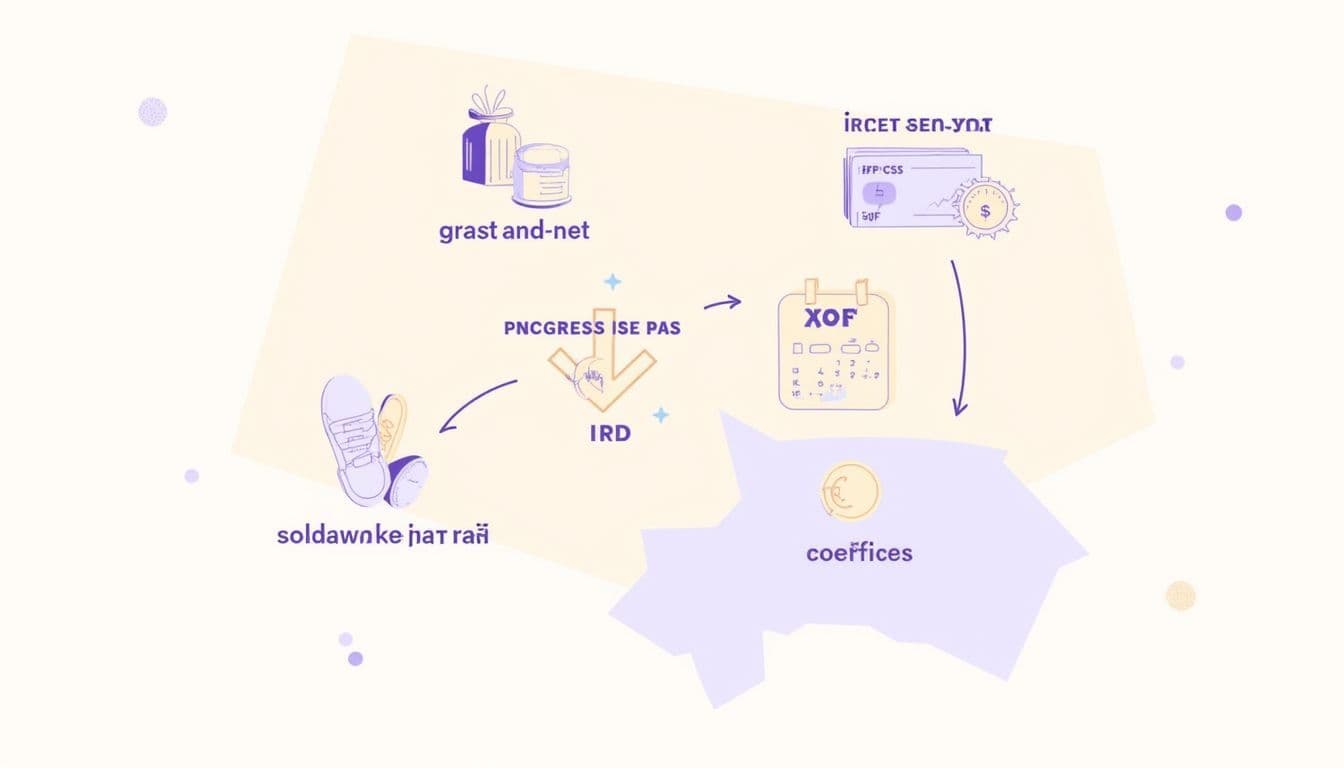
High-level Senegal payroll flow: Gross pay → IRPP withholding → IPRES & CSS → Net pay in XOF → Monthly filings and payments.
Payroll taxes and IRPP (income tax): employer vs. employee obligations
Senegal’s personal income tax, Impôt sur le Revenu des Personnes Physiques (IRPP), applies progressive marginal rates ranging from 0% to 40%. Employers must withhold at source, apply allowances/deductions as permitted, and remit monthly. Payslips—typically in French—should show gross-to-net details, including the taxable base, social contributions, IRPP, and net pay in XOF.
Gross-to-net building blocks:
- Gross remuneration: Base salary plus allowances, in-kind benefits, and variable pay as defined by the contract and applicable CBA.
- Taxable base: Some allowances/benefits may be fully or partially taxable. Tag each earning element correctly in your payroll configuration.
- IRPP calculation: Apply progressive bands to the taxable base after allowable deductions/reliefs. Confirm the latest brackets and thresholds annually and whenever rules change.
Employer responsibilities:
- Registrations: Obtain employer numbers with the tax authority, IPRES, and CSS before first payroll.
- Withholding and remittance: Calculate and withhold IRPP monthly; file declarations and remit by statutory deadlines.
- Recordkeeping: Maintain ledgers, payslips, and income/tax certificates for audits and employee requests.
Employee responsibilities:
- Provide accurate personal data affecting withholding (e.g., marital status, dependents) and notify HR of changes.
- Understand that annual reconciliation may apply if they have non-salary income.
Illustrative example (not tax advice): On a 300,000 XOF monthly salary, compute social contributions (IPRES/CSS), determine the taxable base, apply IRPP progressive rates (0%–40%), withhold IRPP, and pay net salary in XOF. Final figures depend on current brackets, caps, and any eligible deductions.
Quick reference: Key Senegal payroll parameters
- Currency: XOF (West African CFA franc); UEMOA member, euro-pegged.
- Payroll frequency: Monthly; payslips typically in French.
- Minimum wage (SMIG): ~85,890 XOF/month (sectoral CBAs may be higher).
- Standard workweek: 40 hours (confirm sectoral variations).
- IRPP: Progressive 0%–40% (verify current brackets each year).
- Social security: IPRES (pensions) and CSS (health/family). Typical totals: employer ~20%, employee ~6% across schemes.
- 13th month: Not mandated nationwide; may be required by CBA or employer policy.
Social security contributions: IPRES and the CSS
Two institutions anchor social protection in Senegal:
- IPRES (Institut de Prévoyance Retraite du Sénégal): Pension insurance. Under the general scheme, employers contribute roughly 8.4% and employees 5.6% of the applicable salary base. A separate cadre scheme generally carries higher rates and ceilings. Always check current circulars, bases, and caps.
- CSS (Caisse de Sécurité Sociale): Family benefits and workplace injury coverage. As a guide, employers contribute about 7% toward family benefits plus a risk-rated premium for occupational accidents; employees commonly contribute around 3% for health/family coverage. Exact rates and caps vary by scheme and, in some cases, by sector.
Operational guardrails:
- Registration and IDs: Register with IPRES and CSS and store employer and employee IDs before first payroll.
- Bases and ceilings: Configure scheme-specific bases and caps; classify allowances/benefits correctly.
- Monthly cadence: Calculate and pay contributions alongside payroll; retain receipts and reconcile to the GL.
- Employee movements: Update scheme enrollment when roles change (e.g., promotion to cadre), and finalize contributions at termination with any required certificates.
Leave entitlements and employee benefits in Senegal
Annual leave and public holidays
- Annual leave: Employees generally accrue one working day of paid leave per month, with a statutory minimum of about 24 working days per year. Many employers offer up to 30 days based on tenure or policy. Accrual, carryover, and blackout rules may be defined by sectoral CBAs.
- Public holidays: Senegal observes national and religious holidays (e.g., Independence Day, Tabaski/Eid al-Adha, Korité/Eid al-Fitr, Mawlid, Christmas). Maintain a local holiday calendar to manage scheduling, pro-rating, and any overtime implications.
Family and medical leave
- Maternity leave: 14 weeks, typically split before and after birth as prescribed by law. Benefits coordination often involves the employer, the CSS, and any supplemental plans.
- Paternity leave: Short paid leave (often a few days) may apply under the Labour Code or CBAs.
- Sick leave: Entitlements vary by tenure and CBA; medical certificates are commonly required for extended absences.
Working time, overtime, and premiums
- Standard hours: 40 hours per week unless a sectoral agreement states otherwise.
- Overtime and premiums: Premiums depend on timing (night, rest day, public holiday). Configure multipliers and approvals per the applicable CBA.
- 13th month: Not universal; may be mandated by CBA or offered by employer policy—define eligibility and accrual rules upfront.
Step-by-step payroll process in Senegal
- Entity and registrations: Establish your local entity—or use Deel’s Employer of Record (EOR)—and register with the tax authority, IPRES, and CSS. Set up XOF banking and approval matrices.
- Onboarding and data capture: Collect signed French-language contracts, job classification (cadre/non-cadre), dependents, bank details, and right-to-work documents.
- Payroll configuration: Map earnings, allowances, and in-kind benefits; set accruals; and configure IRPP, IPRES, and CSS parameters (bases, caps, and scheme selection).
- Time and attendance: Import standard hours (40/week) and approved overtime/holiday work per applicable CBA rules.
- Gross-to-net: Apply IPRES/CSS, compute taxable income, and withhold IRPP using the current progressive 0%–40% scale. Validate caps and deductions.
- Approvals and payslips: Reconcile results, resolve exceptions, and route for HR/Finance signoff. Issue compliant French-language payslips showing gross-to-net and employer costs.
- Payments and filings: Disburse net pay in XOF and remit IRPP and social security on time with required declarations. Reconcile to ledgers and retain receipts.
- Post-payroll: Archive records, update leave balances, produce variance/compliance reports, and prepare statutory certificates as needed.
Governance reminder: Notice periods and severance depend on contract type, classification, seniority, and dismissal grounds. Always align final pay with the Labour Code and relevant CBAs.
How Deel simplifies payroll in Senegal
- Employer of Record (EOR): Hire in Senegal without opening a local entity. Deel becomes the legal employer, issues compliant French-language contracts aligned to the Labour Code, and manages benefits and terminations.
- Automated gross-to-net and filings: Deel applies IRPP progressive bands and IPRES/CSS rules (including scheme-specific caps), generates compliant payslips, and remits contributions and taxes on time.
- Pay in XOF, fund globally: Fund payroll in major currencies while your team is paid in XOF. Deel handles FX, statutory rounding, and bank file creation.
- Controls and auditability: Role-based approvals, maker–checker workflows, and OHADA-aligned document retention keep you audit-ready. Export journals to your ERP.
- Local expertise: In-country specialists monitor updates to SMIG, IRPP brackets, IPRES/CSS ceilings, and public holidays—so configurations stay current.
Primary CTA: Run payroll in Senegal with Deel. Book a demo to see automated compliance, real-time dashboards, and accurate payouts in action.
Explore more on global payroll and hiring in Africa
Build your Senegal strategy with these popular resources from Deel.
FAQs
What currency is used for payroll in Senegal?
Senegal uses the West African CFA franc (XOF), the common currency for UEMOA. The XOF is pegged to the euro, which helps stabilize payroll budgets for multinational employers.
What is the minimum wage in Senegal?
The national minimum wage (SMIG) is about 85,890 XOF per month. Certain sectors may set higher floors through collective bargaining agreements—always confirm the rate for your industry and role.
How does IRPP (income tax) work in Senegal?
IRPP is a progressive personal income tax with marginal rates from 0% up to 40%. Employers withhold IRPP at source based on the taxable base after social contributions and eligible deductions, and then remit monthly.
Which institutions manage social security?
IPRES administers pensions, and the CSS manages family benefits and workplace injury coverage. Under the general scheme, employers often contribute about 8.4% to IPRES while employees contribute about 5.6%. For CSS, employers commonly pay around 7% plus an accident-risk premium, and employees around 3%—subject to caps and scheme rules.
Can I hire in Senegal without setting up a local entity?
Yes. With Deel’s Employer of Record (EOR), you can hire employees in Senegal without establishing a local entity. Deel issues compliant contracts, runs payroll in XOF, and manages filings with the tax authority, IPRES, and the CSS.